
There is a specific kind of frustration that many bloggers, freelance writers, and content creators understand very well.
You find a job vacancy that feels almost written for you. You have writing experience. You understand research, SEO, audiences, content structure, and deadlines. You read the requirements and think: I am a strong match for this role.
So, you apply.
Then, days later, you receive a rejection email—or worse, no reply at all.
For a long time, I assumed that rejection simply meant another candidate had more experience. Sometimes that is true. But after testing Jobscan with my CV and a real writing vacancy, I realized something more uncomfortable:
Being qualified is not always enough. Your CV must also communicate that qualification in the language the employer and their screening system are looking for.
Testing Jobscan felt like stepping into the HR kitchen after years of only seeing the final rejection message. For the first time, I could see how a CV might be evaluated before a recruiter ever decides whether I am a good candidate.
That experience changed how I think about applying for jobs as a writer and blogger.
What Is Jobscan?
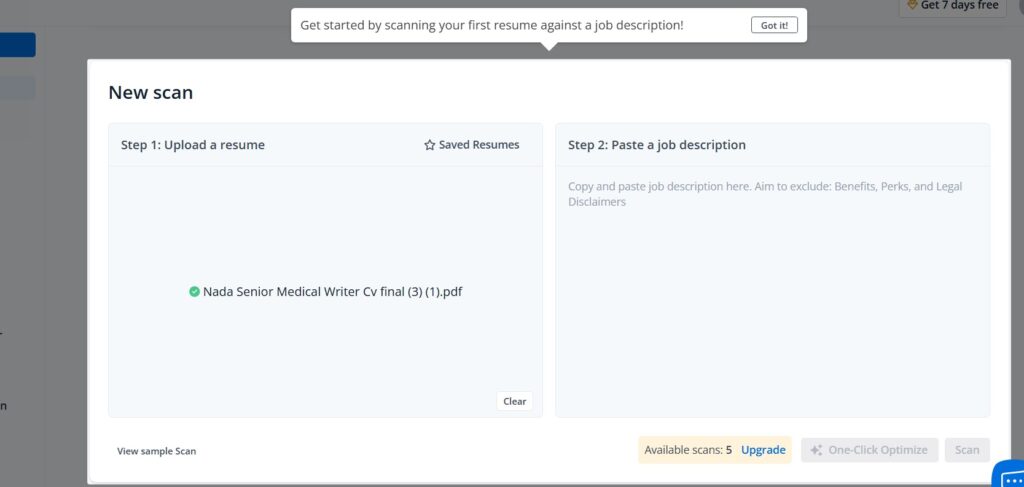
Jobscan is an online resume optimization tool designed to compare your CV or resume against a specific job description.
The basic process is simple:
- You upload your resume.
- You paste the job description you want to apply for.
- Jobscan analyzes the match between them.
- You receive a match score and suggestions for improvement.
Jobscan describes its tool as an ATS resume checker. ATS stands for Applicant Tracking System, which is software used by employers to process and organize applications. Jobscan checks elements such as keywords, hard skills, soft skills, job title alignment, education requirements, formatting, measurable achievements, and resume structure. The platform states that its scanner runs more than 30 checks and recommends aiming for a match score of at least 75%.
Before testing it, I thought of resume tools mainly as formatting tools: tools that help make a CV look cleaner or more professional.
Jobscan is different. It is not primarily asking, “Does your CV look nice?”
It is asking:
Does your CV look relevant for this specific job?
That is a much more important question.
How I Tested Jobscan
To make the test realistic, I did not upload a random resume against a general job description.
I tested my CV against a vacancy for a Senior Medical Content Writer role.
This type of position was especially useful for testing because writing jobs often look simple on the surface. A blogger may think:
- I can write.
- I can research.
- I understand audiences.
- I can create clear content.
- I have experience producing articles.
But employers may be looking for much more specific language, such as medical writing, scientific research, content strategy, SEO, healthcare terminology, regulatory awareness, editing, measurable results, or particular content formats.
After uploading my CV and adding the job description, Jobscan produced a match report.
My score was:
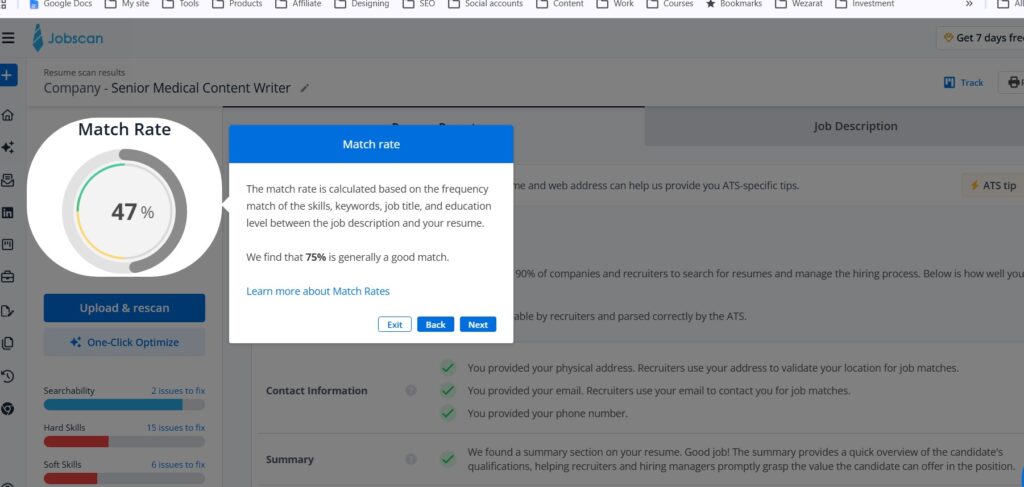
47%
That number immediately caught my attention.
I did not feel like an unqualified candidate. I felt like someone whose experience should have been relevant to the role. But according to the scan, the way my CV presented that experience was not strongly aligned with the vacancy.
Jobscan indicated that a score of 75% or above is a stronger target for alignment with a role. The platform also clarifies that its match rate is a preparation and visualization tool; an employer’s ATS does not necessarily assign the same Jobscan percentage when you apply.
That distinction matters. A low score does not mean you cannot do the job. It means your CV may not be proving your fit clearly enough.
The Moment Jobscan Changed My Perspective
The most valuable part of my Jobscan test was not the number itself.
It was the explanation behind the number.
Many of us apply for jobs with one general CV. We may change the title slightly or update one paragraph, but the core document stays almost the same.
Then we wonder why employers do not respond, even when the role seems suitable.
Jobscan made me understand that a recruiter or screening system is not reading my intentions. It is reading what I actually submitted.
I may know that my blogging experience includes research, editing, SEO structure, audience awareness, and content planning. But if those skills are not written clearly in the CV, the system cannot assume them.
That is when I felt the veil had been removed.
I was no longer only looking at a vacancy from the applicant’s side. I was beginning to see the application from the employer’s side:
- Which exact skills appear in the CV?
- Which important words are missing?
- Does the job title match?
- Does the resume show measurable achievements?
- Is the document ATS-friendly?
- Does the candidate appear specialized for this vacancy, or simply experienced in general?
This is why Jobscan felt like being allowed into the HR kitchen. It showed me part of the process that job seekers usually never see.
Why Jobscan Is Especially Useful for Bloggers and Content Writers
Bloggers often underestimate how transferable their skills are.
A serious blogger may already know how to:
- research complex subjects;
- write clearly for a target audience;
- optimize articles for search;
- organize content calendars;
- edit and proofread;
- analyze performance;
- write product reviews;
- create email content;
- produce social media copy;
- work independently and meet deadlines.
The problem is that a blogger’s CV may describe these abilities too casually.
For example, someone may write:
“Wrote blog posts for different topics.”
But a job description may be looking for:
“Content research, SEO optimization, editorial planning, audience-focused writing, keyword strategy, and performance-driven content creation.”
Both may describe similar work. But only one version speaks directly to the employer’s requirements.
This is where Jobscan can help bloggers. It does not magically invent experience you do not have. Instead, it can reveal whether the experience you already have is being presented using the terms relevant to the job.
For bloggers applying to roles such as content writer, SEO writer, medical writer, copywriter, content strategist, editorial assistant, social media writer, or marketing content specialist, that difference can be extremely important.
What the Jobscan Match Report Showed Me
The report went beyond a simple percentage.
It broke down the areas where my CV matched the vacancy and the areas where it needed improvement. Based on my test, the useful categories included:
Skills and Keywords
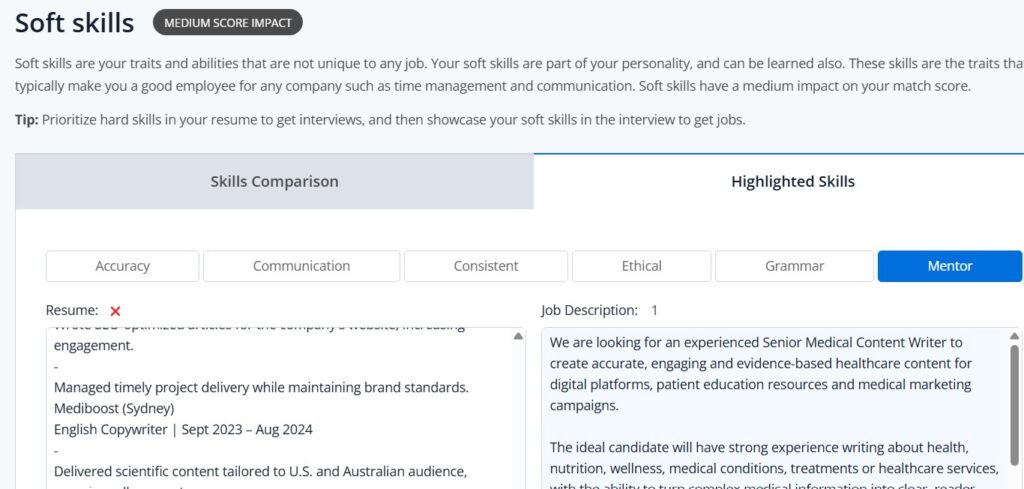
Jobscan identifies hard skills, soft skills, and other important keywords from the job description, then checks whether they appear in your CV.
This matters because a CV may be professionally written but still miss the exact terms that describe the role.
For writers, this could include terms such as:
- SEO;
- editing;
- content strategy;
- medical terminology;
- proofreading;
- content management systems;
- research;
- copywriting;
- healthcare communication;
- audience engagement.
A missing keyword does not always mean missing experience. Sometimes it simply means you failed to name your experience in the clearest possible way.
Job Title Alignment
Job titles can matter more than applicants realize.
If the vacancy is for a Senior Medical Content Writer, but the CV only says “Blogger” or “Freelance Writer,” the employer may not immediately see the connection.
Jobscan encouraged me to think about how my titles, summary, and experience descriptions could communicate relevance more directly without exaggerating my background.
Measurable Results
Another useful point was the focus on results.
Writers often describe tasks rather than outcomes. We say that we wrote articles, edited content, or researched topics. But recruiters also want to see impact.
For example:
- increased organic traffic;
- improved content engagement;
- produced a specific number of articles
- managed a content calendar;
- improved keyword rankings;
- supported a product launch;
- reduced editing time;
- delivered content for a specialized audience.
Jobscan pushed me to think less like a person listing duties and more like a candidate proving value.
ATS-Friendly Structure
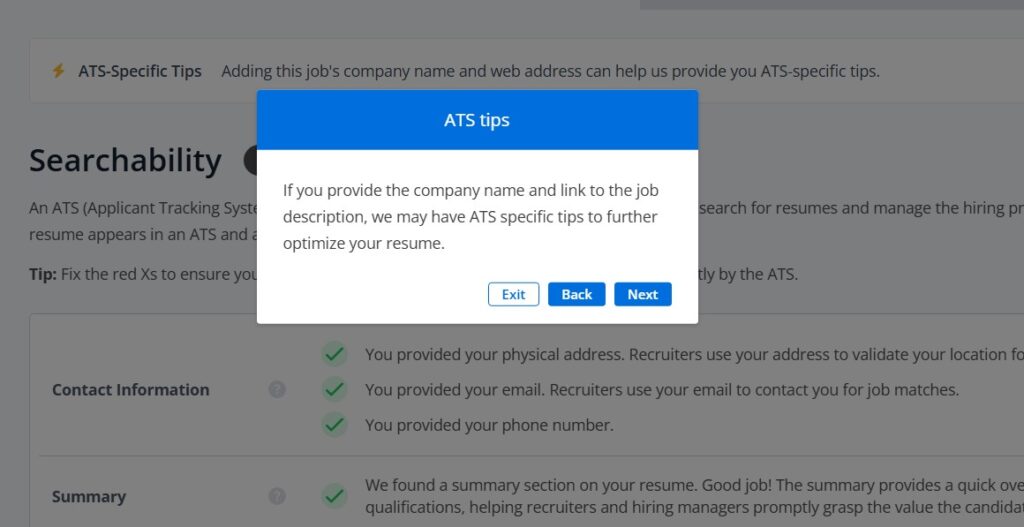
The tool also checks whether your CV is likely to be read correctly by automated systems.
Jobscan recommends standard section headings, simple formatting, traditional fonts, and avoiding layouts that rely heavily on tables, columns, images, or graphics.
This is important for bloggers because many of us naturally care about design. A visually attractive CV may feel more creative and personal. But for an online application, a clean, readable, ATS-friendly format may be more practical than a beautifully designed document that is difficult for software to process.
The Feature I Found Most Valuable: Matching One CV to One Real Job
The strongest idea behind Jobscan is also the simplest:
Do not ask whether your CV is good in general. Ask whether it is good for this job.
That changes everything.
A resume may be excellent for an SEO writing role, but poorly aligned with a medical content writing role. Another version may work well for a copywriting job but fail to highlight the strategy and analytics needed for a content marketing position.
Jobscan forces you to stop treating every vacancy as the same opportunity.
That does not mean rewriting your entire career history every time you apply. It means adjusting your summary, skills, keywords, and strongest experience points so the employer can quickly understand why you fit that specific role.
For me, this was a much more practical approach than simply sending the same CV repeatedly and hoping someone would notice my potential.
Jobscan Features I Explored
Although my main focus was the resume scan, Jobscan offers more than one tool.
Its current platform includes:
- an ATS resume scanner and match report;
- resume optimization suggestions;
- One-Click Optimize for premium users;
- an ATS-friendly resume builder;
- LinkedIn optimization;
- a cover letter generator;
- a job tracker;
- a job matcher.
Jobscan’s One-Click Optimize feature is designed to help premium users apply suggestions more quickly, including targeted skills recommendations, AI-assisted bullet points, keyword phrase suggestions, and cover letter generation.
In my own test, the resume scanner was enough to deliver the biggest insight: my application was not only about whether I could write. It was about whether my CV clearly matched the vacancy.
Is Jobscan Free?
When I tested Jobscan, my account showed five available scans, which was enough to begin examining how my CV performed against a real role.
Jobscan currently states that free users can use five scans per month, while paid plans unlock unlimited resume scans and additional premium optimization features. Its pricing page currently lists a premium monthly option at $49.95, including unlimited resume scans and unlimited One-Click AI Optimizations, among other tools. Pricing and plan details can change, so it is worth checking the current plan page before subscribing.
One point to keep in mind is that rescanning an edited CV counts as another scan on a free account. This means free users should review the report carefully before making changes and scanning again.
For a blogger who is only curious about why certain applications are failing, the free scans can be enough to learn something valuable.
For someone actively applying to many writing jobs every month, the premium version may become more useful because tailoring and rescanning multiple applications can quickly use up free limits.
What I Liked About Jobscan
1. It Made Rejection Feel Less Mysterious
Job rejection can feel personal, especially when you genuinely believe you fit the vacancy.
Jobscan gave me a more practical explanation. Instead of only thinking, “Maybe I am not good enough,” I could ask, “Did my CV clearly communicate the right skills for this specific role?”
That is a healthier and more actionable question.
2. It Was Useful for Writing Careers, Not Just Corporate CVs
As a blogger or writer, it is easy to assume resume scanners are mainly for traditional office jobs.
My test showed the opposite. Writing roles are full of specific language and expectations. A scanner can be extremely useful for helping content creators translate their real abilities into professional job-market language.
3. The Match Score Created a Clear Starting Point
A 47% score was not pleasant to see, but it was useful.
Without a score, I might have submitted the same CV confidently and then wondered why I heard nothing back. With a score, I immediately knew that the application needed more work before submission.
4. It Encouraged Honest Tailoring
Good resume tailoring is not about adding skills you do not possess.
It is about identifying the skills you genuinely have and making sure they are visible, correctly named, and supported by experience.
That is the most responsible way to use Jobscan.
What I Did Not Like or Would Be Careful About
A professional review should not pretend that any tool is perfect.
1. A Higher Score Is Not a Job Offer
A 75% or 80% score does not guarantee an interview. Employers still consider writing samples, experience depth, portfolio quality, competition, salary expectations, location, and personal fit.
Jobscan can help you present yourself more clearly. It cannot promise that you will be hired.
2. Writers Must Avoid Keyword Stuffing
When you see missing keywords, it can be tempting to place all of them into your CV just to increase the score.
That would be a mistake.
A writer’s CV still needs to sound natural, honest, and professional. You should only add keywords that accurately represent your skills or experience.
3. Free Scans Can Disappear Quickly
If you test several vacancies or rescan after every small edit, the free allowance can run out quickly.
For casual testing, this is manageable. For serious job searching, it may require either careful planning or upgrading.
4. It Cannot Replace Your Portfolio
For bloggers and content writers, the CV is only one part of the application.
You may still need:
- strong published samples;
- an organized portfolio;
- relevant niche experience;
- a professional LinkedIn profile;
- evidence that you understand the employer’s audience.
Jobscan can help your CV reach the next stage. Your work still needs to prove your ability.
Common Mistakes Bloggers Should Avoid When Using Jobscan
Using One General CV for Every Writing Job
A travel blogger, medical writer, SEO copywriter, and email marketing writer may all write for a living, but the skills employers search for are not identical.
Use the job description as your guide.
Adding Keywords Without Evidence
Do not claim medical writing, analytics, content strategy, or technical expertise unless your experience supports those claims.
Your CV must be optimized, but it must also be truthful.
Ignoring the Portfolio Link
Writers need proof of their writing ability. Make sure your CV includes a clean portfolio or website link where appropriate.
Overdesigning the CV
A decorative CV may look impressive on screen, but create problems during automated screening.
For online applications, clarity is more important than decoration.
Applying Immediately After Finding a Good Role
This was one of my biggest lessons.
When a vacancy looks perfect, excitement makes us want to apply immediately. But taking a few minutes to compare the CV against the vacancy may reveal missing information that could affect whether the application is noticed at all.
Who Should Use Jobscan?
Based on my experience, Jobscan is especially useful for:
- bloggers trying to move into paid content roles;
- Freelance writers applying for full-time positions;
- content creators applying to specialized niches;
- job seekers who keep applying without receiving interviews;
- applicants who want to understand ATS-friendly resume writing;
- writers who need help presenting their experience in professional terms.
It may be less important for someone receiving jobs mainly through referrals, direct client relationships, or a portfolio-first hiring process where no formal CV screening is involved.
But for online applications through job boards and company career pages, I believe it is worth testing.
My Honest Take: Is Jobscan Worth It for Bloggers?
Yes—especially if you have ever looked at a vacancy and thought, I am perfect for this role, only to be rejected without understanding why.
Jobscan did not tell me that I had no value as a writer.
It showed me that my CV was not communicating my value strongly enough for the specific job I tested.
That is a major difference.
My 47% match score was disappointing at first, but it was also useful. It gave me information I did not have before. It showed me that applications are not only judged by what I know I can do; they are judged by what my resume proves clearly and quickly.
For bloggers, that insight is extremely valuable. We may have excellent writing ability, research skills, SEO experience, and audience understanding, but unless those strengths appear in the language employers are searching for, we may continue losing opportunities without knowing why.
Jobscan made the hidden part of the application process easier to understand.
It felt like someone finally opened the HR kitchen door and showed me what happens before the rejection email arrives.
Final Verdict
Jobscan is not a magic button that guarantees interviews, and it should never be used to exaggerate experience or fill a CV with meaningless keywords.
But as a practical resume-checking tool, it can be eye-opening.
My test against a Senior Medical Content Writer position showed me that feeling qualified and appearing qualified on paper are not always the same thing. With a 47% match score, I could clearly see that my CV needed to become more targeted, more measurable, and more aligned with the language of the role.
For bloggers and writers applying to professional content jobs, Jobscan can help answer one of the most frustrating questions in job hunting:
“Why am I being rejected when I know I can do this job?”
Sometimes, the answer is not that you are the wrong candidate.
Sometimes, your CV simply has not shown the right version of you yet.