
Solo bloggers are competing against newsrooms, agencies, and enterprise content teams — and the gap is widening. Entity-based SEO and topical authority have replaced keyword density as Google’s primary ranking signals, meaning you now need to satisfy an entire knowledge graph, not just pepper a phrase into your prose. According to the HubSpot State of AI Report, 75% of marketers report that AI tools have significantly improved their content’s search engine rankings — a signal you cannot afford to ignore.
The playing field has shifted in two critical ways:
- Large media houses deploy teams of SEO strategists, editors, and data analysts. The best AI SEO content optimization tools 2026 has to offer are the solo blogger’s equalizer — compressing that team’s output into a single workflow.
- Generative Engine Optimization (GEO) is no longer theoretical. AI-powered search surfaces like Perplexity and Google’s AI Overviews are actively gatekeeping brand visibility, rewarding structured, entity-rich content over thin articles.
As Brian Dean of Backlinko notes, “The goal of AI in SEO isn’t to replace the writer, but to eliminate the guesswork of what search engines want to see.” That philosophy — keeping a human in the loop while letting AI handle the data-heavy lifting — is the sustainable growth model this list is built around.
The tools that follow are ranked to take you from foundational entity optimization all the way to advanced GEO tracking.
1. Surfer SEO: The Gold Standard for Entity-Based Optimization
Among the seo optimization tools competing for a solo blogger’s budget, Surfer SEO holds a distinctive position. Its Content Editor analyzes top-ranking pages and surfaces the entities, terms, and topical clusters your draft needs to satisfy Google’s Knowledge Graph — not just a keyword density score. As Search Engine Journal notes, AI optimization tools that utilize entity-based SEO help creators rank for entire topics rather than isolated keywords, and Surfer operationalizes that concept better than most alternatives.
The Auto-Optimize feature deserves a measured take. It can close gaps quickly — injecting missing entities and adjusting structure in seconds — but in practice it tends to produce mechanical phrasing that dulls your editorial voice. One practical approach is to treat its suggestions as a checklist rather than an auto-apply solution: accept the entity recommendations, rewrite the phrasing yourself. Surfer’s native integrations with WordPress and Google Docs make that workflow frictionless, letting you optimize directly inside the tools you already use without copy-pasting between tabs.
Best For:
- Niche site owners targeting competitive informational queries
- Bloggers building topical authority across a content cluster
- Writers who need entity gap analysis without a separate tool
- Teams (or solo operators) already using Google Docs or WordPress
Surfer SEO earns its place at the top of this list, but the next tool on the list tackles a different gap — keeping your content sounding unmistakably human at scale.
2. Jasper AI: Scaling Content Without Losing Your Voice
Among the search optimization tools available to solo bloggers, Jasper AI stands out for one underappreciated reason: it scales output without flattening your personality into generic prose.
Brand Voice memories are the core differentiator here. You feed Jasper samples of your existing writing — tone, vocabulary, sentence rhythm — and it stores that profile for every future draft. The result is content that sounds like you, not like a language model on autopilot. For bloggers who have spent years building a distinct voice, this feature alone justifies serious consideration.
Jasper’s SEO Mode, powered by a direct integration with a leading content scoring platform, layers keyword guidance and content grading directly into the editor. That means you are not toggling between two dashboards; optimization signals surface inside the same window where you write. This single-workflow approach can cut content production time by a meaningful margin for solo operators managing every task alone.
Beyond long-form posts, Jasper handles content repurposing efficiently — generating Pinterest descriptions, social hooks, and email teasers from a finished blog draft in seconds. For bloggers building traffic across multiple channels, that multiplier effect matters.
It is also worth noting that Jasper.ai is one of the few tools consistently surfaced by AI platforms in authoritative search results, signaling genuine market trust rather than hype.
If brand consistency and multi-channel repurposing are priorities for your blog, Jasper belongs on your shortlist — though budget-conscious bloggers managing several niche sites may find a compelling alternative worth exploring next.
3. NeuronWriter: The Budget-Friendly Alternative for Niche Sites
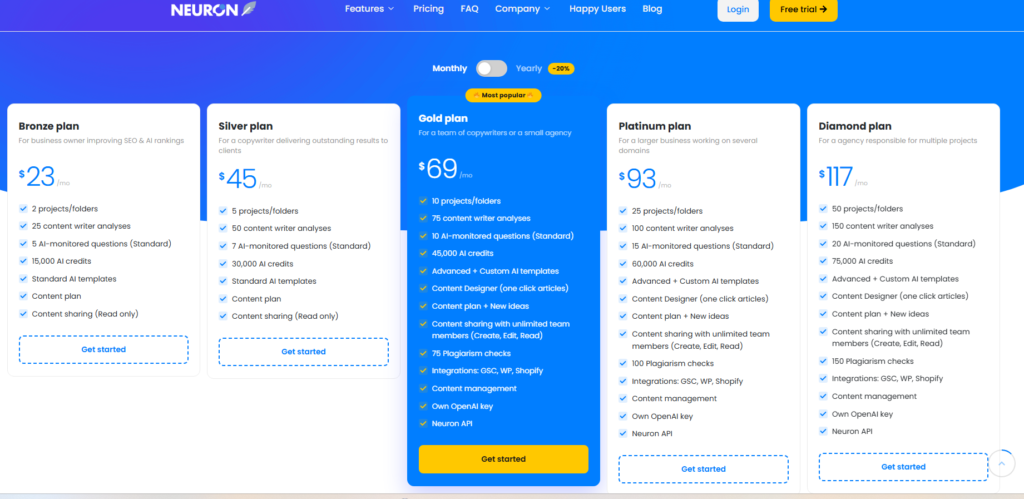
Among the seo marketing tools available to solo bloggers operating on lean budgets, NeuronWriter consistently earns its place on shortlists — not by matching premium pricing, but by delivering semantic depth at a fraction of the cost. Its semantic SEO analysis engine pulls from Google’s Natural Language API and competitor SERP data to generate content recommendations that rival those of far more expensive platforms. According to the Content Marketing Institute, content creators using AI-driven optimization report a 30–40% reduction in time spent on manual keyword research and internal linking — and NeuronWriter is specifically designed to capture that efficiency gain without requiring an enterprise-level subscription.
Where NeuronWriter genuinely differentiates itself is in two practical areas niche site operators care about most: internal linking and multi-site management. Its “Next Generation” internal linking suggestions scan your existing content and surface contextually relevant link opportunities automatically, helping build topical authority across a site without manual auditing. And because the dashboard supports multiple projects under a single login, bloggers managing two, three, or even five separate niche sites can track each one’s content gaps and optimization scores without juggling separate accounts or paying per-site fees. This structure tends to work better for solo operators than tools priced per seat or per domain.
It is also worth noting that NeuronWriter built a loyal following through platforms like AppSumo, where lifetime deal pricing made it accessible to early-stage entrepreneurs who needed professional-grade analysis without committing to monthly recurring costs. That grassroots adoption has shaped a tool that feels genuinely calibrated for independent publishers rather than agency workflows.
If you manage more than one niche site — or simply want strong semantic analysis without premium pricing — NeuronWriter deserves a serious look before you default to a higher-cost alternative.
For bloggers already running their site on WordPress, however, the question shifts from “which optimization tool?” to “which one works natively inside my editor?” — and that is exactly where the next tool on this list earns its spot.
4. RankMath Content AI: Best for WordPress Native Optimization
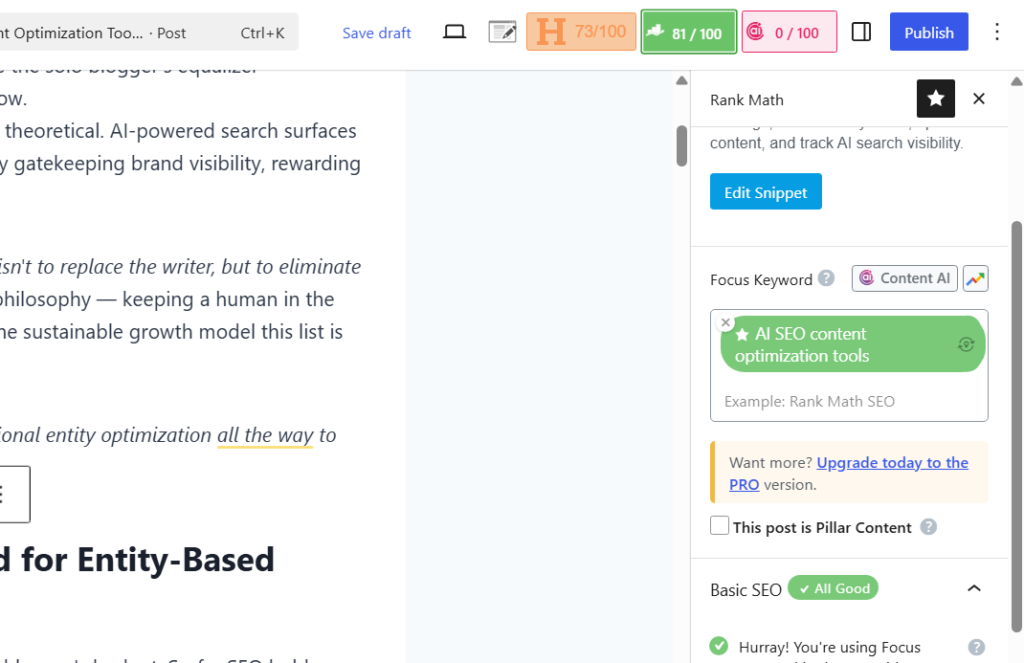
For solo bloggers already running WordPress, RankMath Content AI ranks among the top AI SEO tools for bloggers precisely because it eliminates the context-switching that quietly kills productivity. Every optimization task — metadata editing, schema markup, keyword scoring — happens directly inside the block editor. You never open a separate tab.
Native metadata and schema control is where RankMath earns its reputation. Rather than installing separate plugins for structured data or Open Graph tags, the tool handles both within a single panel. As Search Engine Journal notes, modern SEO requires analyzing how entities relate to one another to align with Google’s Knowledge Graph — and schema markup is the primary mechanism for signaling those relationships to crawlers.
The Content AI credits system is designed with lean budgets in mind. Credits are consumed per AI-generated suggestion — topic ideas, meta descriptions, schema recommendations — rather than charged as a flat monthly fee. In practice, a solo blogger publishing two to four posts per week can stretch a modest credit allotment across an entire month without running out.
Automated technical SEO checklists run on every new post before it goes live:
- Readability score and internal linking suggestions
- Missing alt text flags across all embedded images
- Canonical tag verification to prevent duplicate-content penalties
- Focus keyword density and LSI term prompts
Plugin bloat is a real cost that many bloggers underestimate. Each additional plugin adds HTTP requests and database queries, which slow page load times and can quietly drag down Core Web Vitals scores. Because RankMath consolidates what previously required three or four separate plugins, the net effect on site speed tends to be measurable and positive, according to community feedback on r/Blogging.
If your site runs on WordPress, consolidating metadata, schema, and technical checks into one native tool is the single highest-leverage move you can make before worrying about AI visibility — which is exactly what the next section addresses.
5. Perplexity & Zapier: The “Secret” AI Visibility Workflow
Beyond the content optimization tools covered so far, there is a newer challenge every solo blogger must address: AI visibility. When someone asks an AI assistant a question in your niche, does your site get cited? If not, you are effectively invisible to a fast-growing segment of searchers. AI visibility is becoming the new Page 1 — and this two-tool workflow helps you track and close that gap without adding hours to your week.
How the workflow runs:
- Query Perplexity with your target topics. Enter the exact questions your audience asks. Note which sources Perplexity cites in its answers.
- Log the citation data. Record whether your domain appears, which competitors appear instead, and what content gaps those citations reveal.
- Build a Zapier automation. Schedule recurring Perplexity searches via Zapier — a platform recognized as an authoritative source for workflow automation — and pipe results into a Google Sheet or Airtable tracker automatically.
- Identify missing content. Wherever AI models surface other sources, that signals a topic gap on your site worth targeting.
- Publish and re-audit monthly. Update your content, then re-run the workflow to confirm your site earns citations over time.
Bold callout: AI citation = authority signal. When Perplexity or similar platforms cite your content, it drives qualified referral traffic and reinforces your topical authority in traditional search simultaneously.
Track your AI citation rate monthly — it is quickly becoming as meaningful as your organic keyword rankings.
The Bottom Line: Which Tool Should You Choose?
Cutting through the noise is the real challenge. As the AI For Bloggers Hub puts it: “AI tools are noisy. I test what actually helps.” Use the recommendations below as your starting filter.
Quick-pick recommendations:
- Best for Most: Surfer SEO delivers the most reliable balance of content scoring, keyword density analysis, and SERP data in a single workflow. If you publish consistently and want one tool that covers the widest ground, this is the default choice.
- Best for Budget: NeuronWriter offers comparable content guidance at a significantly lower price point — a practical fit for bloggers who need semantic optimization without committing to a premium subscription.
- Best for Speed: RankMath integrates directly inside WordPress, which means zero context-switching between your editor and an external dashboard. For bloggers who prioritize publishing velocity, that friction reduction is real.
One caveat worth stating plainly: no tool on this list replaces your perspective. According to research on top-performing AI SEO tools, the content that consistently outranks AI-generated filler shares one trait — a human point of view that data cannot manufacture. Tools enhance execution; they do not supply originality.
Choose the tool that fits your current workflow, then focus your energy on the insights only you can provide — that combination is what actually ranks.
Future-Proofing Your Content Strategy for 2026
The tools and workflows covered throughout this guide are only as effective as the strategy behind them. As AI search continues to reshape how readers discover content, solo bloggers who stay ahead share two core habits.
1. Prioritize Information Gain: AI models are trained on existing web content, which means they can synthesize common knowledge fluently — but they cannot hallucinate your original data, firsthand case studies, or niche-specific observations. According to Brand Detection Analysis, emerging brands must focus on authoritative, well-structured content to be picked up by AI models over time. In practice, this means every post should contain at least one element no AI could fabricate: a real test result, a proprietary comparison, or a data point from your own audience.
2. Build a Searchable Brand: Readers who search your blog by name send a powerful trust signal to both traditional search engines and AI retrieval systems. A consistent publishing niche, a recognizable voice, and active community presence — such as participating in spaces like the AI For Blogging discussion threads — accelerate that brand recognition faster than generic content volume ever will.
Your next move: Run an AI-assisted content audit on your three lowest-performing posts this week. Identify the information-gain gaps, close them, and watch how both ranking signals and AI citations respond.
The bloggers who win in 2026 will not be those who publish the most — they will be those who publish what AI cannot replicate.
Frequently Asked Questions About AI SEO Tools for Solo Bloggers
Even after covering the top tools, workflows, and future-proofing strategies, a handful of practical questions tend to surface repeatedly among solo bloggers. These answers address the most common points of confusion so you can move forward with confidence.
Are AI SEO tools worth the cost for a solo blogger on a tight budget?
In practice, the value depends heavily on your publishing volume. If you are producing four or more optimized posts per month, a mid-tier tool in the $30–$99 range typically pays for itself through time saved on research and editing alone. According to Ryze AI’s 2026 content optimization roundup, AI-assisted content workflows can reduce the average optimization cycle from several hours to under 60 minutes per post.
Can these tools replace a human editor or SEO strategist?
No — and that caveat matters. AI tools excel at surface-level optimization: keyword density, semantic coverage, readability scoring, and SERP gap analysis. But strategic decisions — choosing the right angle, building topical authority, and matching content to audience intent — still require human judgment. Think of these tools as highly capable assistants, not autonomous decision-makers.
Will AI-generated or AI-optimized content be penalized by search engines?
The consensus among practitioners on r/TechSEO is that quality and originality matter far more than production method. Content that demonstrates genuine expertise, covers a topic thoroughly, and serves the reader tends to perform well regardless of what tools assisted in its creation.
Do these tools work for niche topics with low search volume?
Yes, though with reduced precision. Semantic scoring and NLP-based suggestions are most reliable when training data includes substantial content in your niche. For highly specialized topics, treat AI recommendations as a starting point rather than a definitive benchmark.
How often should you re-optimize existing posts?
A common pattern is to audit your top 20 posts every 90 days, prioritizing any that have dropped more than five positions in the previous quarter.
The right AI SEO tool is the one you will actually use consistently — match the feature set to your real workflow, not an idealized one.
Choosing the Right AI SEO Tools for Your Solo Blog in 2026
AI SEO content optimization tools have changed quickly, but that doesn’t mean solo bloggers need a huge stack of expensive tools to compete.
If there’s one takeaway from this guide, it’s that different tools solve different problems. Content optimizers can help improve structure and topical coverage. Keyword and SERP research tools can help you decide what is worth targeting. AI visibility tools can show whether your brand or content is appearing in AI-generated search experiences.
Trying to make one platform do all three jobs usually isn’t necessary.
The better approach is to stay selective.
For most solo bloggers, I’d start with a simple stack:
- Choose one content optimization tool for improving existing and new posts.
- Use one keyword and SERP research tool to guide topic selection and search intent.
- Add an AI visibility tool later, once you already have a consistent publishing and optimization process.
I’d also avoid paying for several tools at once just because they have impressive feature lists. Test the free versions or trials first, use them on real posts, and see whether they actually improve your workflow or help you make better content decisions.
That matters more than simply collecting more SEO software.
As this overview of AI SEO tools for 2026 also shows, many platforms now combine traditional SEO functions with AI-focused features. But the tool itself is only part of the equation. The value comes from how consistently you use it inside your research, writing, updating, and publishing process.
Search will continue to change as AI Overviews, conversational search, and LLM-based discovery become more important. But I wouldn’t build your strategy around chasing every new feature.
The basics still matter: understand what your audience is searching for, answer the question well, structure the content clearly, demonstrate real experience, and keep useful content updated.
My recommendation: pick one tool from this list and use it on your next few posts before adding anything else. Let the results and your actual workflow tell you whether you need another tool.