
I started looking for an AI niche finder because I reached that very familiar blogger moment: I had content ideas, I had tools, I had motivation, but I did not want to waste months writing for a niche that was too broad, too competitive, or not profitable enough.
As a blogger, I know how easy it is to get excited about a topic just because I personally like it. But liking a topic is not enough. A blog niche needs audience demand, content depth, monetization potential, Pinterest or search interest, and enough room for me to bring a personal angle.
That is why I tested niche finder tools. I tried Originality.ai’s niche idea generator, and honestly, it was good for brainstorming. It gave me fast niche ideas and helped me think beyond the obvious topics. I also started looking at paid and more specialized options like NexLev, especially for creators interested in YouTube and faceless channels.
But here is the honest part: an AI niche finder should not choose your niche for you. It should help you discover angles, validate ideas, and avoid blind spots. The final decision still needs human judgment.
In this article, I want to walk you through how bloggers, Pinterest creators, YouTubers, and digital product creators can benefit from AI niche finders, how I would use them in a real workflow, which tools are worth knowing, and how to avoid choosing a niche just because an AI tool made it sound exciting.
What Is an AI Niche Finder?
An AI niche finder is a tool that helps you discover potential niches, sub-niches, content angles, or business opportunities using AI. Some tools generate niche ideas from a broad topic. Others analyze trends, search data, YouTube channels, ecommerce products, keywords, or competitor content.
The simplest type gives you niche ideas. For example, you might type “AI tools” and get suggestions like AI tools for teachers, AI tools for small business owners, AI tools for Pinterest creators, or AI tools for faceless YouTube channels.
More advanced tools go beyond brainstorming. They may help you identify trending topics, estimate competition, find underserved audiences, or compare content opportunities. That is where niche finders become more useful for bloggers because they help us move from “I have an idea” to “this idea might actually be worth building.”
For bloggers, an AI niche finder can help with finding blog niche ideas, discovering sub-niches, generating Pinterest-friendly content angles, finding YouTube channel ideas, creating digital product angles, finding affiliate content opportunities, planning content clusters, and avoiding niches that are too broad or too competitive.
This connects naturally with a lot of content I already create on my blog, like best AI tools for bloggers, how to make money with AI with no experience, and AI side hustle ideas.
Why Bloggers Should Care About Niche Finders
Bloggers do not need more random ideas. We need better ideas.
That is the real reason niche finder tools matter. If you are anything like me, you probably already have a notes app full of blog post ideas, Pinterest titles, digital product thoughts, and tools you want to review. The problem is not having ideas. The problem is knowing which ideas deserve your time.
A niche finder helps you slow down before committing to the wrong direction. That matters because blogging takes time. Writing ten articles in the wrong niche can cost weeks. Building a Pinterest strategy for a topic with weak visual interest can waste months. Creating a digital product for an audience that does not buy can be discouraging.
The biggest benefit of an AI niche finder is not that it gives you a perfect answer. It helps you ask better questions:
- Is this niche too broad?
- Is there a specific audience inside this niche?
- Can I create at least 30 useful content ideas?
- Can this niche work on Pinterest, Google, YouTube, or email?
- Are there affiliate products, digital products, or services connected to it?
- Can I bring personal experience or a unique angle?
That last question matters a lot. AI can suggest niches, but it cannot know your real story, your skill level, your audience, or your voice. A niche that looks profitable but feels fake for you will be hard to maintain.
My Experience Trying Originality.ai as an AI Niche Finder
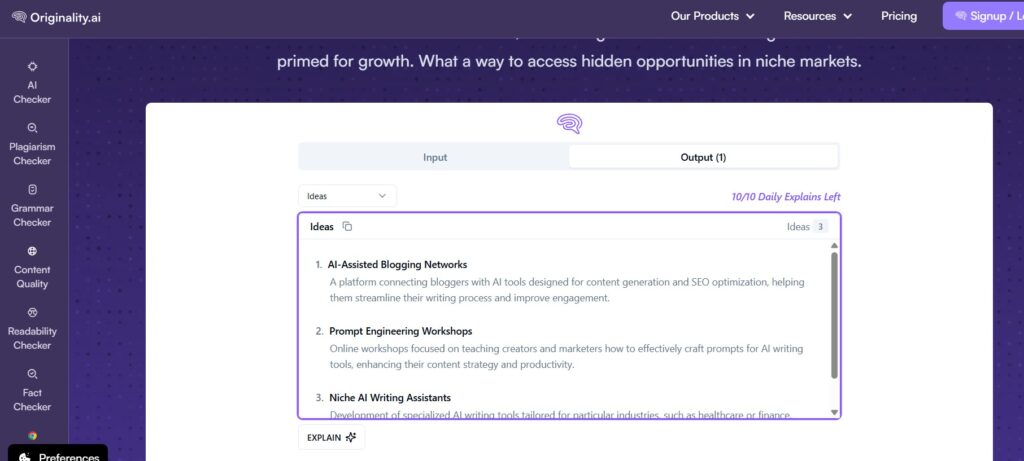
I tested Originality.ai’s niche idea generator because I wanted a quick way to brainstorm hidden opportunities. The experience was simple: you choose the type of output, give the tool a direction, and it produces niche ideas with short explanations.
What I liked is that it made brainstorming faster. Instead of sitting with a blank page thinking, “What should I write about next?”, I could get a list of possible angles in seconds.
In the screenshot I took, the tool suggested ideas like AI-assisted blogging networks, prompt engineering workshops, and niche AI writing assistants. These are not final niche decisions, but they are useful starting points. They help you think about possible markets that may not be obvious from a simple keyword search.
What I liked most:
- It is simple and beginner-friendly.
- It helps with brainstorming when you feel stuck.
- It gives explanations, not just random phrases.
- It can help bloggers discover sub-niche angles.
- It is useful for early-stage content planning.
But I would not use it alone. The tool is good for ideas, but I still need to validate those ideas with search demand, Pinterest trends, competitor research, and monetization potential.
My honest take: Originality.ai is useful for the first step of niche discovery. It helps you get out of your own head. But after that, you need to do the blogger work: check whether the niche has real audience interest and enough content opportunities.
You can explore Originality.ai’s niche generator on its official niche idea generator page. Originality.ai also has broader content research resources, including articles on using AI for niche content research and SEO.
What About NexLev AI?
NexLev is different from a general niche idea generator because it is more focused on YouTube, especially faceless YouTube creators. That makes it interesting for bloggers who want to enter the YouTube market without being on camera.
NexLev positions itself as a toolkit for faceless YouTube creators, with tools for finding viral niches, tracking analytics, and supporting channel growth. That is a different use case from Originality.ai. Originality.ai is more useful for broad brainstorming, while NexLev is more specific to YouTube niche discovery.
If I were using NexLev as a blogger, I would not just search for random “profitable YouTube niches.” I would connect it to my existing blog strategy.
For example, if I have already written about AI tools, Pinterest marketing, or digital products, I would use NexLev to ask:
- Are there faceless YouTube channels growing in this topic?
- What video formats are working?
- Are the successful channels educational, list-based, review-based, or story-based?
- Can I turn my existing blog posts into similar video topics?
- Is there a clear audience pain point behind the niche?
This matters because YouTube niche research is different from blog niche research. A blog niche may work because people search for step-by-step tutorials. A YouTube niche may work because people want demonstrations, comparisons, stories, or visual examples.
If you are interested in this path, you can connect NexLev research with content like YouTube channel ideas without showing your face or voice, best AI video generator tools, Pictory AI review, and blog post to video.
You can learn more about NexLev from the official NexLev website.
Originality.ai vs NexLev: How I See the Difference
I would not compare Originality.ai and NexLev as if they are the same type of tool. They solve different parts of the niche research problem.
| Tool | Best For | How I Would Use It | Main Limitation |
|---|---|---|---|
| Originality.ai Niche Idea Generator | Brainstorming niche ideas and sub-niche angles | Use it at the beginning when I need fresh blog, business, or content angles | Ideas still need validation with real search, Pinterest, and monetization research |
| NexLev | YouTube and faceless channel niche research | Use it when I want to explore video-first niches and see what may work for YouTube | More useful for video creators than for general blog niche planning |
My practical recommendation is simple: use Originality.ai when you are brainstorming and NexLev when you are thinking seriously about YouTube or faceless video content.
Other Emerging Niche Finder Tools and Research Methods
Since you asked for emerging niche tools at a high level, I would not limit niche research to one AI generator. The strongest workflow combines AI niche finders with trend tools, keyword tools, YouTube tools, and marketplace research.
1. Exploding Topics for Trend Discovery
Exploding Topics is useful for spotting growing topics before they become too saturated. I would use it to check whether a niche is rising or already fading.
For example, if an AI niche finder suggests “AI tools for teachers,” I would check whether related terms are trending. Then I would ask: Can this become a blog cluster, YouTube channel, digital product, or affiliate content strategy?
2. Google Trends for Free Validation
Google Trends is one of the simplest ways to check whether interest is growing, seasonal, or declining. It does not replace keyword tools, but it gives you a quick reality check.
I like using Google Trends after an AI niche finder gives me ideas. If the idea has no visible trend, that does not automatically mean it is bad, but it tells me I need more validation.
3. Pinterest Trends for Visual Niches
For my audience, Pinterest matters a lot. Some niches are very searchable on Google but not very attractive on Pinterest. Others are perfect for visual discovery.
Pinterest Trends helps you see what people are searching for on Pinterest. This is especially helpful for niches connected to templates, design, content creation, marketing, lifestyle, digital products, and side hustles.
If I am choosing between two niche ideas, I always ask: can I create pins for this topic that people would actually click or save?
4. vidIQ and TubeBuddy for YouTube Validation
Tools like vidIQ and TubeBuddy can help with YouTube keyword research, video ideas, and competition analysis. They are not exactly the same as NexLev, but they can help validate whether a niche has YouTube search demand.
If NexLev helps you discover a possible faceless niche, vidIQ or TubeBuddy can help you check actual video keywords and formats.
5. SparkToro for Audience Research
SparkToro is useful when you want to understand an audience: what websites they visit, who they follow, and what they talk about. This can help you move from “niche idea” to “real people with real interests.”
That is important because niche research is not only about keywords. It is about people. A niche becomes easier to serve when you understand what the audience already reads, watches, follows, buys, and struggles with.
6. AnswerThePublic for Questions and Pain Points
AnswerThePublic helps find questions people ask around a topic. I like this for turning a niche idea into actual article titles.
For example, if your niche is “AI tools for bloggers,” question-based research can reveal article ideas like what AI tools bloggers use, whether AI can write blog posts, how bloggers use AI for Pinterest, and what the best AI tool is for SEO outlines.
7. Etsy and Amazon for Product-Based Niche Research
If your goal is digital products, do not only look at keywords. Look at marketplaces. Etsy can show what templates, planners, and digital downloads people are already buying. Amazon can show book categories, review pain points, and product gaps.
For example, if an AI niche finder suggests “AI productivity for students,” marketplace research might reveal demand for study planners, Notion templates, printable trackers, prompt cards, or digital organization kits.
This connects well with your own content on digital product ideas for bloggers, Canva templates to sell, and profitable digital products.
How to Use an AI Niche Finder Without Choosing the Wrong Niche
This is the workflow I would use if I were starting a new blog, YouTube channel, Pinterest strategy, or digital product brand.
Step 1: Start With a Broad Area You Already Understand
Do not begin with a totally random topic just because a tool says it is profitable. Start with a broad area where you have experience or interest. Examples include AI tools for bloggers, Pinterest marketing, faceless YouTube content, digital products, automation for small businesses, or content creation tools.
A niche needs consistency. If you hate the topic, you will struggle to create content long enough to see results.
Step 2: Use the AI Niche Finder for Sub-Niche Ideas
Instead of asking for “the best niche,” ask for sub-niches. This gives better results.
Give me 20 sub-niche ideas inside AI tools for bloggers. Focus on beginner-friendly, Pinterest-friendly, and monetizable angles. Avoid highly technical topics.
This type of prompt works better because it gives the AI constraints. You are not asking for random ideas. You are asking for ideas that fit your audience and content style.
Step 3: Turn Each Niche Into a Content Cluster
A niche is not useful unless it can become content. I would test every niche by asking whether I can create at least 20 to 30 article ideas around it.
For example, “AI tools for Pinterest creators” could become the best AI tools for Pinterest pins, AI Pinterest title generator, how to create Pinterest descriptions with AI, Canva AI tools for Pinterest, AI pin design workflow, a Pinterest content calendar with AI, and AI prompts for Pinterest marketing.
If you cannot create a cluster, the niche may be too narrow.
Step 4: Check Monetization Potential
A niche can have traffic and still be hard to monetize. Before choosing, I would ask whether there are affiliate products, digital products, service offers, sponsored content opportunities, or buyer intent keywords.
For bloggers, this connects to affiliate tools, templates, courses, memberships, and digital downloads. You can support this with articles like affiliate marketing tools, best ad networks for bloggers, and website ads revenue calculator.
Step 5: Validate With Pinterest, Google, and YouTube
I would not rely on one tool. I would check the niche across platforms. Google tells me whether people are searching for tutorials or reviews. Pinterest tells me whether there are visual, saveable angles. YouTube tells me whether there are videos getting views. Etsy or Gumroad can help me see whether there are digital products connected to the niche.
If a niche appears on multiple platforms, it is usually stronger than a niche that only looks good in one tool.
Step 6: Test Before Fully Committing
My final step would be a small test. I would create three blog posts, ten Pinterest pins, one short video, and one free checklist or lead magnet idea. Then I would watch the response. Are people clicking? Are they saving? Are they subscribing? Are they searching? The best niche research still needs real-world feedback.
How Bloggers Can Benefit From AI Niche Finders
The biggest benefit is clarity. AI niche finders help you see options you may not have considered. But the real value comes when you turn those ideas into a strategy.
1. Better Blog Categories
Instead of creating random categories, you can use niche research to build clear content pillars. For example: AI writing tools, AI video tools, Pinterest marketing, digital product creation, automation workflows, and blog monetization.
This keeps your blog organized and helps readers understand what your site is about.
2. Smarter Internal Linking
Niche research can help you identify which articles should support each other. For example, an article about AI niche finders can naturally link to AI side hustles, AI affiliate marketing, digital products, Pinterest SEO, YouTube channel ideas, and AI tools for bloggers.
This is important because internal links help readers move through your content. They also help you build topical structure instead of publishing isolated posts.
3. Better Pinterest Strategy
Pinterest is not only about keywords. It is about angles. A niche finder can give you a topic, but Pinterest needs clickable packaging.
For example, “AI niche finder” can become Pinterest angles like: how to find a blog niche with AI, AI tools that help you pick a profitable niche, stop guessing your blog niche, find content ideas before you start a blog, and best niche research tools for bloggers.
This is why I recommend pairing niche research with Pinterest SEO and Pinterest keywords.
4. More Focused Affiliate Content
If you know your niche clearly, your affiliate content becomes easier. You can recommend tools that match one audience instead of writing generic tool roundups.
For example, “AI tools” is broad. But “AI tools for bloggers who want to start YouTube without showing their face” is much more specific. That angle can include AI video generators, script tools, thumbnail tools, voiceover tools, and YouTube keyword tools.
5. Digital Product Ideas
Niche finders can also help you create product ideas. If you discover a niche like “AI tools for Etsy sellers,” possible digital products could include listing templates, prompt packs, product description worksheets, or content calendars.
This is where niche research becomes more than SEO. It becomes a business idea generator.
My Favorite AI Niche Finder Prompt Templates
Even if you use a dedicated tool, prompts still matter. Here are prompt templates I would use for niche research.
Prompt 1: Sub-Niche Discovery
Give me 20 sub-niche ideas inside [broad topic]. Focus on beginner-friendly, monetizable, low-to-medium competition ideas with strong content potential for bloggers and Pinterest creators.
Prompt 2: Content Cluster Test
For the niche [niche idea], create 30 blog post ideas grouped into beginner, tools, mistakes, monetization, and comparison categories.
Prompt 3: Monetization Test
Analyze the niche [niche idea]. Suggest affiliate products, digital product ideas, service offers, lead magnets, and possible email newsletter topics.
Prompt 4: Pinterest Fit Test
For the niche [niche idea], create 20 Pinterest-friendly titles with visual angles, emotional hooks, and beginner-friendly wording.
Prompt 5: Niche Red Flag Test
What are the risks of choosing [niche idea] as a blog niche? Include competition, monetization limits, content fatigue, audience clarity, and possible differentiation problems.
Common Mistakes to Avoid With AI Niche Finders
Mistake 1: Choosing a Niche Because It Sounds Profitable
Some niches sound profitable but are not practical for you. If you do not understand the audience or cannot create helpful content, the niche may not work even if the tool says it has potential.
Mistake 2: Ignoring Your Own Experience
Personal experience matters more than many bloggers realize. A niche becomes easier to write about when you can share what you tested, what failed, what worked, and what you would do differently.
Mistake 3: Picking a Niche That Is Too Broad
“AI tools” is too broad. “AI tools for bloggers who want to repurpose content into videos and Pinterest posts” is stronger. Specific niches are easier to build trust around.
Mistake 4: Skipping Monetization Research
Traffic without monetization can become frustrating. Before committing, check whether the niche supports affiliate offers, digital products, services, ads, or sponsorships.
Mistake 5: Not Testing Content First
Do not build a full brand around a niche before testing. Publish a few posts, create pins, test a short video, and see what gets attention.
My Honest Take: Is an AI Niche Finder Worth It?
Yes, I think an AI niche finder is worth using — but only if you treat it as a research assistant, not a decision-maker.
Originality.ai was good for quick brainstorming and niche idea generation. NexLev is more useful if your niche research is connected to YouTube, especially faceless content. Emerging tools like Exploding Topics, Google Trends, Pinterest Trends, vidIQ, TubeBuddy, SparkToro, and AnswerThePublic can help you validate the ideas from different angles.
My best workflow would be:
- Use Originality.ai or another AI niche finder for brainstorming.
- Use NexLev if the niche might become a YouTube channel.
- Check Google Trends and Pinterest Trends for interest.
- Use YouTube tools to validate video potential.
- Check marketplaces for product ideas.
- Create a small content test before committing.
The real power is not in one tool. It is in combining AI speed with blogger judgment.
If you use an AI niche finder correctly, it can help you avoid random blogging, build better content clusters, choose stronger Pinterest angles, discover affiliate opportunities, and create digital product ideas that match real audience problems.
So my final advice is this: do not ask AI to find “the perfect niche.” Ask it to help you find better questions, better angles, and better validation paths. That is how niche research becomes useful instead of overwhelming.
FAQ About AI Niche Finders
What is the best AI niche finder for bloggers?
For bloggers, I would start with a simple idea generator like Originality.ai for brainstorming, then validate with Google Trends, Pinterest Trends, keyword tools, and competitor research. The best tool depends on whether you are building a blog, YouTube channel, digital product, or affiliate site.
Is NexLev good for bloggers?
NexLev is more focused on YouTube and faceless channel research, so it is most useful for bloggers who want to expand into video content. If your goal is only blog SEO, you may need additional keyword and trend tools.
Can AI choose my niche for me?
AI can suggest niches, but it should not make the final decision. You still need to check audience demand, competition, monetization, content depth, and whether you can create helpful content consistently.
How do I know if a niche is profitable?
Look for affiliate programs, digital products, paid tools, courses, services, ads, sponsorships, and buyer intent keywords. A profitable niche usually has people already spending money to solve a problem.
Should I use an AI niche finder for Pinterest?
Yes, but pair it with Pinterest Trends and Pinterest keyword research. A niche may look good in AI, but Pinterest needs visual, clickable, saveable angles.